WHITE RANGOLI POWDER VS COLOURED RANGOLI:WHICH LOOKS BETTER
May 15, 2026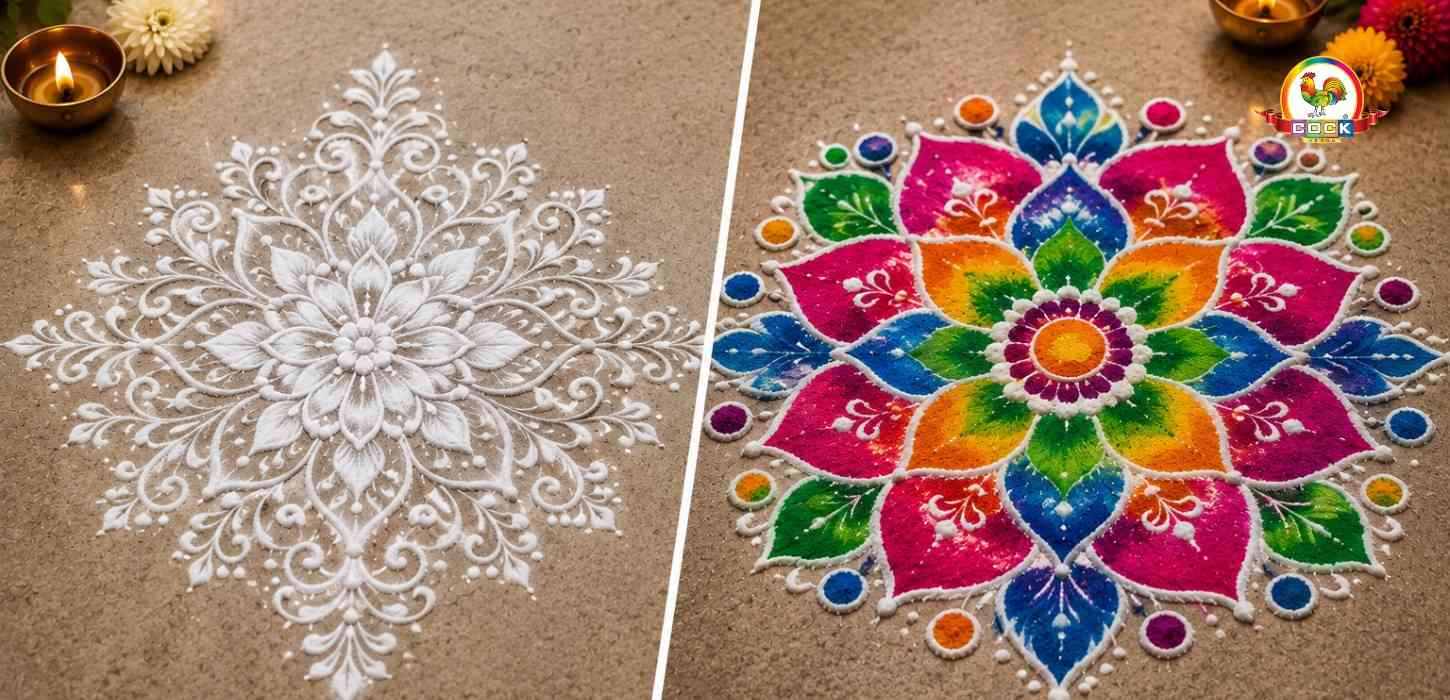
When you set out to make a rangoli — whether for Diwali, a pooja, a wedding, or just a Sunday morning ritual — one of the first decisions you make is also the most overlooked: do I reach for the white powder or the colours? It sounds simple. But the choice actually shapes everything — the mood of the design, how long it takes, how forgiving it is of mistakes, and how it photographs. This post breaks down both options honestly, so you can pick what actually works for your occasion, your space, and your skill level.
What Is White Rangoli Powder, Exactly?
White rangoli powder — often called white outliner or safed rangoli — is a fine, chalk-like powder traditionally made from ground rice flour, marble dust, or chalk powder. It flows smoothly, sits cleanly on the floor, and dries without smudging.
Its role in traditional Indian culture is more than decorative. White powder has been used for centuries to draw outlines, mark sacred thresholds, and create geometric patterns that are precise and meditative in nature. In many South Indian households, kolam or muggulu — drawn only in white — is made fresh every single morning.
The Rimjhim White Outliner Rangoli Bottle (250gm) from Cock Colours is built for exactly this purpose: a precision-nozzle bottle that lets you draw clean lines, fine curves, and delicate patterns without mess or finger fatigue.
What Is Coloured Rangoli Powder?
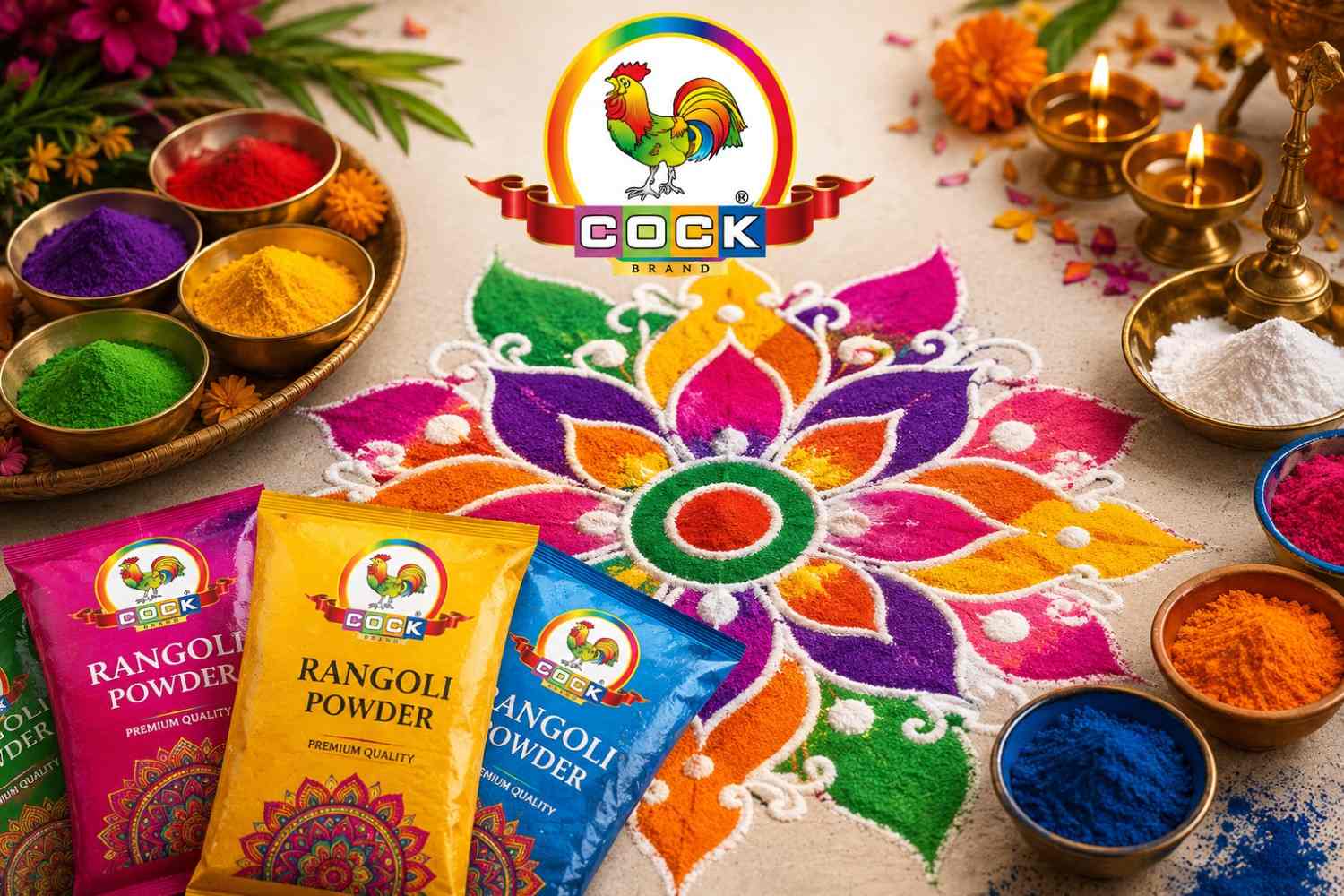
Coloured rangoli powder brings vibrancy, celebration, and full visual impact to a design. It is typically used to fill in the outline — adding petals, gradients, and decorative motifs — or to create bold, standalone patterns without any white outline at all.
Modern coloured rangoli has evolved significantly. Today you'll find:
Standard colours in classic shades like red, yellow, green, blue, and orange
Neon colours that glow under light for festive evenings
Glitter rangoli that catches light and creates a shimmer effect
Ready-to-fill bottle sets that make colouring precise and beginner-friendly
Cock Colours' Decora range covers all of these — from the Rangoli Powder Online for traditional filling, to Decora Neon Rangoli Colours, Decora Glitter Rangoli Pens, and Decora EasyBottle Rangoli Colours for modern, fuss-free decoration.
White Rangoli: The Case for Staying Minimal
There's a reason kolam has survived thousands of years without a single drop of colour. White rangoli has a purity to it that is genuinely hard to replicate.
Where white rangoli truly shines:
1. Traditional and devotional settings:
For daily poojas, temple entrances, Navratri setups, or Vastu rituals, white rangoli feels spiritually appropriate. The minimalism reflects intention and focus rather than decoration for its own sake.
2. Marble and light-coloured floors:
On grey marble, cream tiles, or white granite, white rangoli creates a subtle, elegant contrast — like an etching or a carving rather than a painting. The design reads beautifully without competing with the floor.
3. Outlining before colouring:
Most experienced rangoli artists start every design in white. The outline gives structure, corrects proportion, and allows confident colouring afterward. Think of it the way a painter thinks of pencil sketches.
4. Speed and daily use:
A white kolam or geometric pattern can be drawn in under five minutes by a practiced hand. There is no colour-filling, no blending, no drying time. It's practical for everyday use.
5. Forgiving for beginners:
White powder is easier to manage than multiple colours. One powder, one bottle, one design — there's less decision-making involved, which means less anxiety.
The trade-off: White rangoli on dark floors or in large outdoor spaces can look understated — which is a strength indoors but a weakness when you want visual impact at a distance.
Coloured Rangoli: The Case for Going All In
If white rangoli is a whisper, coloured rangoli is a celebration.
Where coloured rangoli truly excels:
1. Diwali, weddings, and large gatherings:
No other decoration announces a festival quite like a vivid, multi-coloured rangoli in a doorway or courtyard. The combination of warm yellows, rich reds, and deep blues immediately communicates joy and welcome.
2. Photography and social media:
Coloured rangoli is simply more photogenic. The contrast between shades, especially when you use complementary colours or neon tones, creates images that stand out sharply — even in low indoor light or candlelit evenings.
3. Dark or patterned floors:
On terracotta tiles, dark grey stone, or patterned flooring, white alone tends to get lost. Colour fills the visual gap and makes the design pop regardless of the surface underneath.
4. Themed and contemporary designs:
Modern rangoli has moved beyond traditional motifs. Mandalas, floral gradients, peacock patterns, geometric art — all of these demand colour to feel complete. Neon and glitter variants take this even further, creating designs that look entirely different under daylight vs. evening lighting.
5. Tools that make it accessible:
Products like the Decora EasyBottle Rangoli Colours and Decora Glitter Rangoli Pens have changed the game for those who love colour but struggle with mess or control. Precision-nozzle bottles mean even kids can participate without the design falling apart.
The trade-off: More colours mean more time, more decisions, and more room for colour-bleed if the floor is uneven or slightly damp. Coloured rangoli also doesn't suit daily use as easily — it's better suited for occasions.
Head-to-Head: White vs Coloured at a Glance
The Smartest Answer: Use Both Together
Here's the truth that experienced rangoli artists know: the real question isn't which one looks better — it's which one does what job better.
White and coloured rangoli are not competitors. They are partners.
A sharp white outline gives your design structure, proportion, and crisp boundaries. Colour fills that structure with life. The result is a rangoli that is both precise and vibrant — the best of both approaches.
This is exactly why Cock Colours offers products that serve both roles distinctly. The Rimjhim White Outliner Rangoli Bottle handles the outline work. The Decora Rangoli Powder pouches handle the fill. The Decora Glitter Rangoli Pens add the finishing shimmer. And for those who want everything in one go, the COCK BRAND Quick Rangoli Mega Set brings multiple tools together.
Choosing Based on Occasion — A Quick Guide
Daily morning kolam or pooja: White rangoli powder only. Keep it simple, keep it sacred.
Dussehra / Navratri: White outline + ochre yellow, red, and orange fills. Traditional yet warm.
Diwali: Go full colour — deep reds, warm golds, bright greens. Add glitter accents near diyas for a magical evening effect.
Wedding ceremonies: Marigold yellows, deep pinks, and white outlines. Use stencils for consistency across large areas.
Contemporary home décor / social media post: Neon colours or glitter rangoli. Maximise contrast, photograph in natural light.
Kids' activity: Coloured easy-bottles or the Decora Magic Rangoli Maker with stencils — no mess, full fun, surprisingly good results.
A Note on Quality
Whatever you choose — white or coloured — the quality of the powder matters more than most people realise. Low-quality rangoli powder clumps, bleeds, or fades quickly. It sticks to hands and doesn't flow evenly from bottles, making the whole process frustrating.
Cock Colours' rangoli range is formulated for consistent flow, vibrant pigment retention, and clean lines. The white outliner, in particular, is engineered for precision work — so the lines you draw stay where you put them.
Final Word
White rangoli is timeless, meditative, and deeply rooted in Indian tradition. Coloured rangoli is joyful, expressive, and visually powerful. Neither is objectively better — what matters is knowing which one fits the moment. Use white when you want clarity and devotion. Use colour when you want celebration and impact. Use both when you want the best rangoli you've ever made.
Explore the full Cock Colours rangoli range — including the Rimjhim White Outliner, Decora EasyBottle colours, Neon and Glitter sets, and ready-made design kits — at Cock Colours
Frequently Asked Questions
Q1. Can I use white rangoli powder as an outline before filling with colour?
Yes — this is actually the recommended approach for detailed designs. Draw your pattern in white powder first to set the boundaries, then fill each section with coloured rangoli powder. It gives cleaner edges and a more professional result.
Q2. Which rangoli powder is better for a dark floor?
Coloured rangoli, especially bright or neon shades, shows up much better on dark or patterned floors. White rangoli can look faint on dark surfaces. If you prefer white, use it on light-coloured tiles or marble for the best contrast.
Q3. Is white rangoli powder safe for daily use?
Yes. Traditional white rangoli powder made from rice flour or marble dust is safe for daily use on home floors. It is non-toxic and can be easily swept away after use.
Q4. What is the difference between Rimjhim and Decora rangoli products from Cock Colours?
Rimjhim is Cock Colours' white outliner range, designed specifically for precision outline work. Decora is the coloured rangoli range, available in standard, neon, and glitter variants with easy-fill bottles and stencil kits for all skill levels.
Q5. Which rangoli is easier for beginners?
White rangoli is simpler to start with since you only manage one material. For coloured rangoli, beginners should try the Decora EasyBottle sets or the Decora Magic Rangoli Maker — the bottle design and stencils remove much of the difficulty.
Q6. Can I mix neon and standard colours in the same rangoli design?
Absolutely. Mixing neon accents with standard colours adds depth and visual interest. A common technique is using standard fills for larger sections and neon colours for the borders or central motif.
Q7. How do I stop rangoli colours from spreading or bleeding into each other?
Always draw a clear white outline before filling with colour. The outline acts as a barrier. Also, ensure the floor is completely dry before you begin — moisture is the most common cause of colour bleed.
Q8. Where can I buy Cock Colours rangoli powder online?
The full Cock Colours rangoli range — including white outliners, coloured pouches, neon bottles, glitter pens, and complete rangoli kits — is available at cockcolours and on Amazon India.